


Page 23 - Demo
P. 23
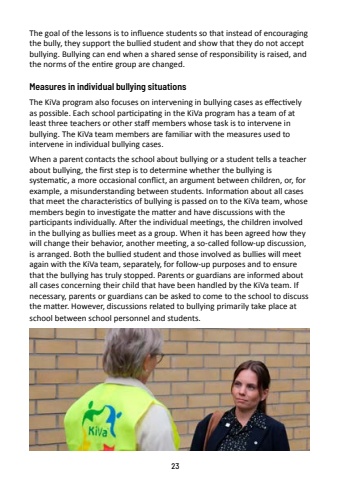
23The goal of the lessons is to influence students so that instead of encouraging the bully, they support the bullied student and show that they do not accept bullying. Bullying can end when a shared sense of responsibility is raised, and the norms of the entire group are changed.Measures in individual bullying situationsThe KiVa program also focuses on intervening in bullying cases as effectively as possible. Each school participating in the KiVa program has a team of at least three teachers or other staff members whose task is to intervene in bullying. The KiVa team members are familiar with the measures used to intervene in individual bullying cases.When a parent contacts the school about bullying or a student tells a teacher about bullying, the first step is to determine whether the bullying is systematic, a more occasional conflict, an argument between children, or, for example, a misunderstanding between students. Information about all cases that meet the characteristics of bullying is passed on to the KiVa team, whose members begin to investigate the matter and have discussions with the participants individually. After the individual meetings, the children involved in the bullying as bullies meet as a group. When it has been agreed how they will change their behavior, another meeting, a so-called follow-up discussion, is arranged. Both the bullied student and those involved as bullies will meet again with the KiVa team, separately, for follow-up purposes and to ensure that the bullying has truly stopped. Parents or guardians are informed about all cases concerning their child that have been handled by the KiVa team. If necessary, parents or guardians can be asked to come to the school to discuss the matter. However, discussions related to bullying primarily take place at school between school personnel and students.


